
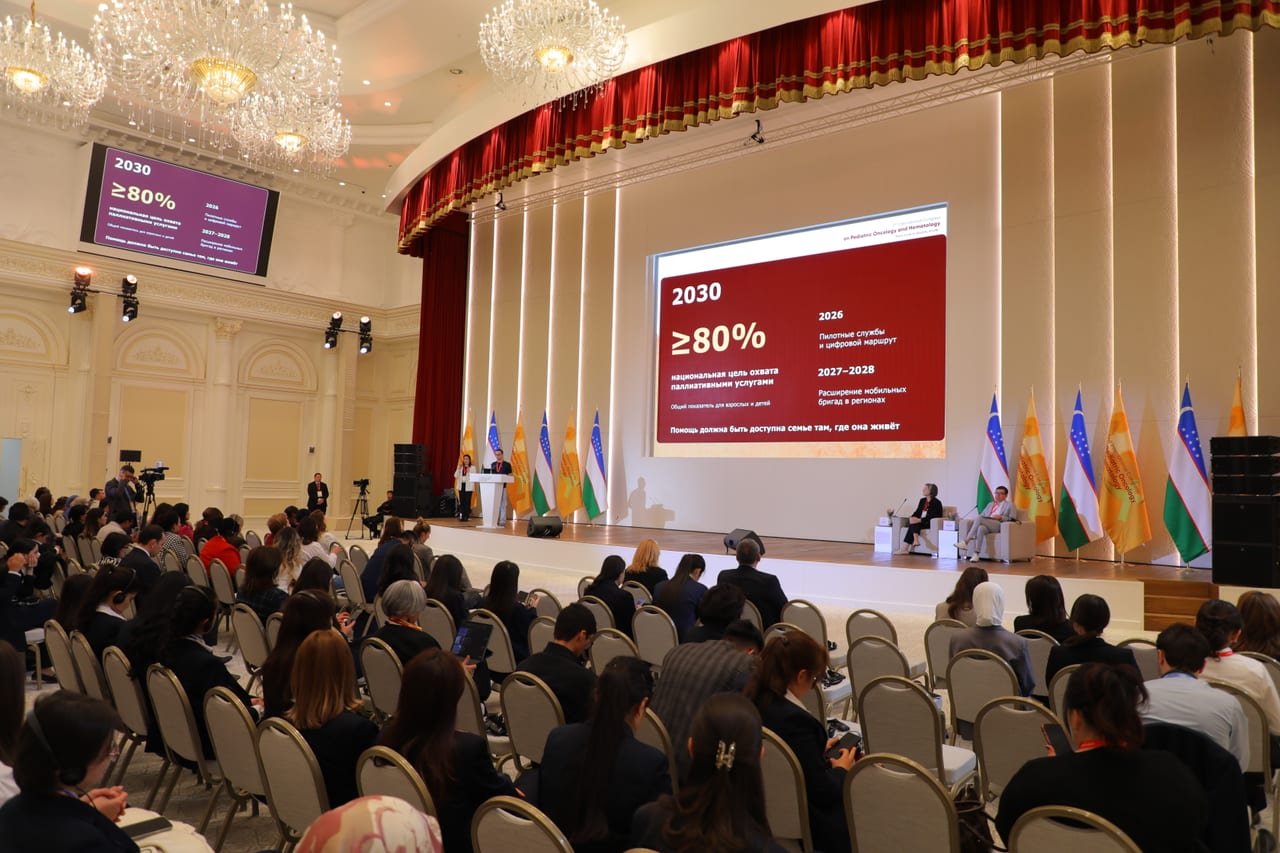
The II International Congress on Childhood Oncology, held as part of the World Summit “Investing in Children’s Wellbeing” in Samarkand, continued its work. The second day of the Congress focused on modern methods of treating cancer in children, improving the effectiveness of care in complex clinical cases, preventing infectious complications, and comprehensive support for sick children and their families.
Today, childhood oncology is one of the areas of healthcare that demands particular attention and a comprehensive approach. Treating children with cancer depends not only on modern medical technologies but also on timely diagnosis, individual treatment strategies, and the development of rehabilitation and palliative care services.
With this in mind, the four thematic sessions held on the second day of the Congress aimed to discuss pressing issues in the field from different angles, analyse modern clinical approaches and share international experience.
Palliative care: quality of life for the child and family
One of the Congress’s key themes was palliative care for children with serious and life-threatening illnesses.
Palliative care is not only medical care provided at the final stage of illness. It is a comprehensive approach that addresses the physical, psychological and social needs of children living with serious illness, relieves pain and other distressing symptoms, and supports their families.
The effectiveness of such care depends on collaboration between medical staff, psychologists, social workers and other specialists. During long-term treatment in particular, it is important to take into account the child’s emotional state, the family’s social needs and the difficulties they face in daily life.
The session paid particular attention to improving the palliative care system, enhancing quality of life for children and their families, and ensuring continuity between medical and social services.
Participants were also briefed on the work under way in Uzbekistan to develop palliative care for children.
In particular, it was noted that on 28 September 2026 a mobile palliative care service for children with serious and incurable illnesses was launched in Samarkand region for the first time. More than 300 children in the region have been identified as needing such care, and the new service provides them with medical and social support where they live, as well as support for their families.
An important feature of the mobile palliative service is that it reduces the need to constantly take seriously ill children to medical facilities, allows care to be provided in a familiar family setting and eases the caregiving burden on parents.
The launch of this service in Samarkand region was cited as a practical example of bringing palliative care closer to where children live, linking medical and social services, and developing a family-centred support system.
This experience shows that developing palliative care requires not only wider coverage of medical services but a comprehensive approach aimed at improving the quality of life of seriously ill children and their families.
Paediatric tumour surgery: modern technologies and treatment options
The second thematic session was devoted to modern strategies for the surgical treatment of tumours in children.
Surgery in childhood oncology is complex and demands great precision. The main goal is to remove the tumour as safely as possible while minimising the impact on the child’s healthy tissue, organ function and future quality of life.
In modern surgical oncology, accurate diagnosis, correct assessment of the tumour’s location and characteristics, and coordination of surgery, chemotherapy and other treatments all play an important role.
Choosing a treatment that takes into account the growth and development of a child’s body is especially important, because the outcome of an intervention is judged not only by control of the disease but also by the child’s future physical development and quality of life.
Discussions centred on modern approaches to paediatric tumour surgery, choosing treatment strategies in complex clinical cases and expanding access to care.
Sharing scientific and practical experience in this field matters for developing multidisciplinary teams in childhood oncology and for making treatment safer and more effective.
High-risk neuroblastoma: new approaches to a complex disease
The next session of the Congress addressed the treatment of high-risk neuroblastoma, one of the malignant tumours that occur in children.
Neuroblastoma is a malignant tumour that develops from certain cells of the nervous system and occurs mainly in early childhood. Its high-risk form is marked by a complex course and the need to combine several treatment methods.
In such cases, the treatment strategy is determined by the stage and biological features of the disease, the child’s age and general health.
Modern medicine treats high-risk neuroblastoma with chemotherapy, surgery, radiotherapy and, in some cases, stem cell transplantation and immunotherapy.
Fighting this disease therefore depends on bringing research findings into clinical practice, developing individual treatment plans and ensuring collaboration between specialists of different disciplines.
The session discussed expanding treatment options for high-risk neuroblastoma, advanced medical approaches and the management of complex clinical cases.
These discussions highlight the need to improve treatment of high-risk diseases in childhood oncology and to make effective use of modern medical experience.
Infection control: a key condition for safe treatment
The fourth thematic session of the Congress covered modern strategies for preventing and controlling infections in childhood oncology.
Children with cancer, especially during chemotherapy and other intensive treatment, may be at high risk of infectious complications.
One of the main reasons is that some treatments temporarily weaken the body’s immune defences. As a result, infections that would normally be mild can pose a serious threat to children undergoing cancer treatment.
Preventing infections, detecting them early and treating them promptly are therefore among the key factors that determine the quality of care in childhood oncology.
Infection control is not limited to individual medical procedures. It also includes compliance with sanitary and hygiene standards in health facilities, regular assessment of infection risks, use of laboratory diagnostics and safety measures throughout treatment.
The session examined the prevention of infectious complications, modern infection control strategies and patient safety during cancer treatment.
Progress in this area is important for reducing treatment-related risks, ensuring continuity of care and improving children’s chances of recovery.
A comprehensive approach: the foundation of effective care in childhood oncology
The four themes discussed on the second day of the Congress are closely interlinked and demonstrated the need to organise care in childhood oncology comprehensively.
Alongside introducing modern surgical methods and expanding treatment options for complex cancers, preventing infectious complications, developing palliative care and supporting families are all integral parts of the overall treatment process.
Success in childhood oncology should be measured not only by the results of medical procedures but also by the child’s quality of life, their physical and psychological wellbeing, the support their family receives and their ability to adapt to life after treatment.
From this perspective, coordinated medical and social services, collaboration between specialists from different fields and learning from international best practice are particularly important.
The II International Congress on Childhood Oncology in Samarkand became an important international platform for discussing these issues, analysing modern approaches in the field and sharing professional experience.
The main significance of the Congress discussions lies in their focus on treating every stage of care in childhood oncology — from diagnosis and treatment to palliative care, rehabilitation and family support — as a single system.
Such an approach is essential to expanding children’s access to quality medical services, putting their interests first throughout treatment and protecting the life and health of every child.