
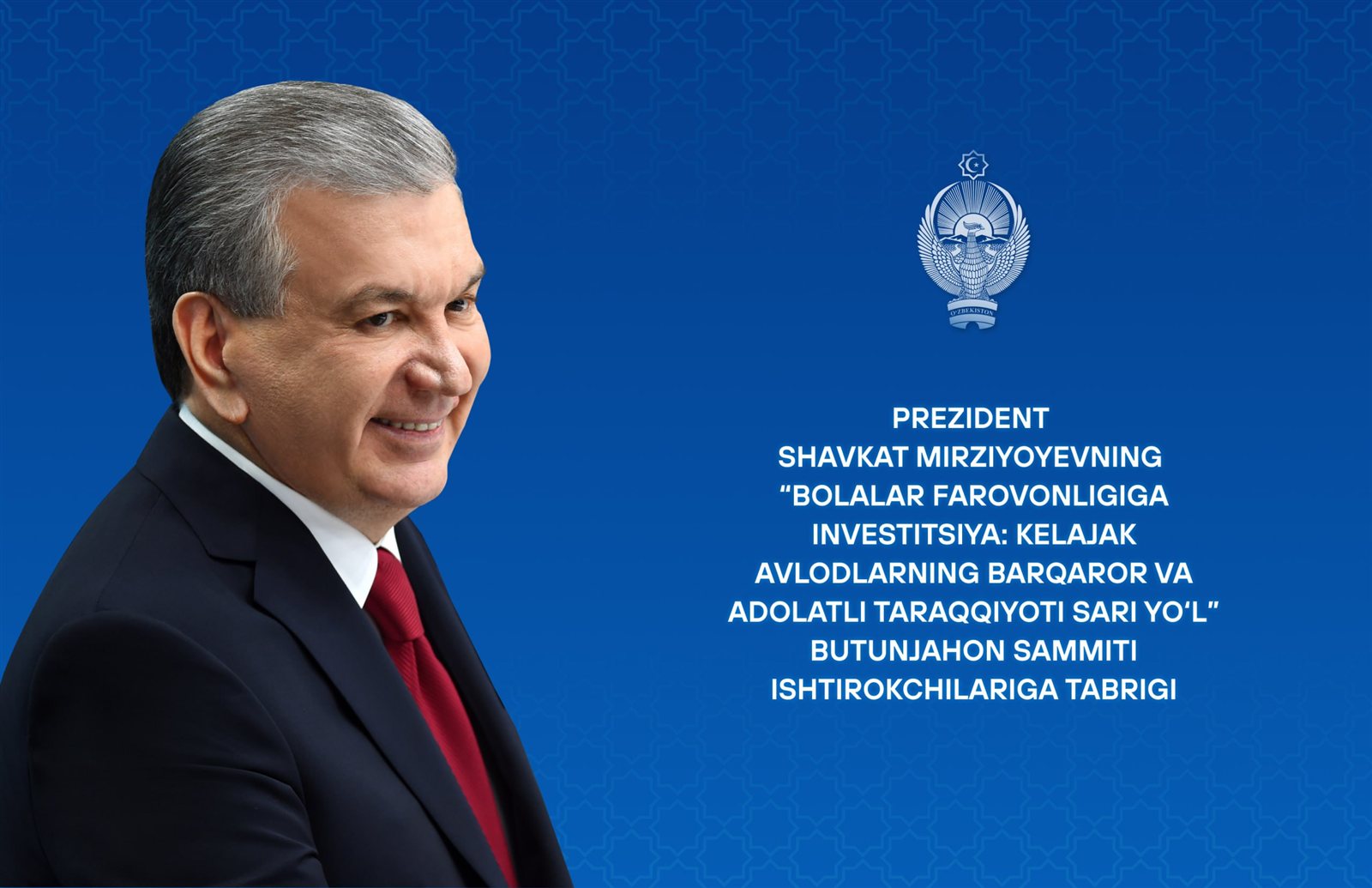
Distinguished Summit participants!
Dear guests, ladies and gentlemen!
I wholeheartedly congratulate you on the opening of the World Summit “Investing in Children’s Wellbeing: A Pathway to Sustainable and Equitable Development for Future Generations” in the eternal city of Samarkand.
I express my gratitude to the United Nations and its Children’s Fund, UNICEF, the World Bank, the World Health Organization, the International Social Security Association and all our partners who are cooperating in organising this forum.
When we speak of children’s wellbeing, we mean, above all, their lives today. Every child, right now, is entitled to love, safety, quality education and the medical care they need. A child’s worth is not measured by the profession they will have in the future or by how much income they will bring.
The conditions created for a child to grow up healthy and realise their abilities also lay a solid foundation for a country’s long-term development. That is why resources directed to childhood must hold a consistent and lasting place in state policy.
In Uzbekistan, we are continuing reforms to protect maternal and child health, expand access to preschool education and bring social services closer to families. We are paying particular attention to the participation of children with disabilities in education and to protecting children from violence and exploitation.
As a result of our far-reaching reforms, maternal mortality in childbirth and stunting among children have halved, preschool education coverage has risen from 27.7 per cent to 78 per cent, almost 100 per cent of six-year-olds are enrolled in school preparation, and higher education coverage has increased fivefold, from 9 per cent to 45 per cent.
Through the social protection system we have created in our country, which identifies the needs of families and children early and provides support, child poverty has fallen almost fourfold over the past five years.
At the same time, thanks to the reforms of the past two years, the number of inclusive schools has increased fivefold, and more than 85 per cent of children with disabilities are now enrolled in educational services.
The real result of this work must be felt in the life of every family. Does a doctor reach a child in a remote area in time? Does the child have the conditions they need to learn at school? If they face violence, can they ask for help with confidence? We must judge our work by the practical answers to these questions.
For us, supporting the family means ensuring the child’s safety and best interests. This requires timely support for parents, preventing children from being separated from their families and, where necessary, finding them safe and stable family-based care.
That is why it is a priority for us that every child grows up in a family environment built on love and care. Today, 100 per cent of orphans and children left without parental care are being raised in families.
We have a saying: “For one child, seven mahallas are parents.” It embodies the idea of never being indifferent to a child and never leaving a family on its own. Today this tradition must be reinforced by clear state guarantees, the work of qualified professionals and respect for every child’s personal integrity.
We strive to enrich the compassion and solidarity of our national experience with the world’s best knowledge. This is how we understand our idea of “O‘Z”: knowing one’s own worth, respecting the worth of others and taking responsibility for the future.
A child should grow up drawing strength from their own language and cultural roots while looking at other peoples with respect. Expanding their opportunities to ask questions, think independently, create and master the world’s knowledge is how this idea is expressed in real life. Every child in Uzbekistan should have such opportunities, regardless of their nationality, language, faith, health or family income.
Distinguished participants!
Armed conflicts, forced displacement, climate change and economic hardship are taking a heavy toll on children’s lives. Every state must fulfil its responsibilities, and international cooperation must complement national capacities.
I propose that we focus our dialogue in Samarkand on the following practical areas.
First, we need to strengthen continuous support from the earliest period of a child’s life. It is important to link maternal health, proper nutrition, early development and preschool education. The earlier a need is identified, the more timely the help that reaches the family.
We propose expanding cooperation in the early detection and treatment of serious illnesses in children. In particular, specialists in childhood oncology need to share experience, and diagnostic capacity and access to quality medicines must be improved. Where a child lives should not limit their chance of receiving help.
To this end, we support the First Ladies’ initiative for international cooperation in childhood oncology. Its public and charitable potential should be linked to the recommendations of medical experts, needs-based assistance and transparent spending of funds. This cooperation should serve to strengthen the capacity of national health systems.
Another priority is creating a safe learning and digital environment for children. We need to strengthen cooperation against cyberbullying, exploitation and the misuse of personal data.
At the same time, we must broaden children’s opportunities to learn, create and communicate safely. This requires practical support in digital literacy for children as well as for parents and teachers.
We also propose making children’s participation an integral part of our decisions. We need to hear their own views on the services being created for them. Such participation should be organised in a way that is age-appropriate, voluntary and safe.
To continue cooperation in these areas, we are interested in developing the Samarkand Platform as a mechanism for practical dialogue. Working with existing organisations, it could serve to share effective practices, prepare voluntary joint projects and discuss results.
I hope that the Summit’s final declaration will express our shared aspirations. To turn it into practical action, it is important to develop plans with interested partners that set out responsibilities, resources and timelines. Openly discussing results against agreed indicators will strengthen mutual trust.
In doing so, our attention must be focused especially on children who are being left without help. Progress towards wellbeing becomes our shared achievement when it is felt in the life of every child.
Dear friends!
A child does not choose the country or the family they are born into. But the conditions we create for them to grow up safely, discover their abilities and build their future depend on our decisions.
I wish for the cooperation that has begun in Samarkand to continue with concrete action that improves children’s lives today.
I wish you all good health, success in your important work and fruitful results for the Summit.
Shavkat Mirziyoyev, President of the Republic of Uzbekistan